![logo-dynamic-[Converted]_01.gif](https://static.wixstatic.com/media/7c2942_a28e8bab1a3749ec83a2d55382226f70~mv2.gif)

Mar Nostro - Notre Mer - بَحرُنا
Palais du Pharo, Marseille, France 2026
A site-specific installation for the 2026 Mediterranean Season.
Design and construction: UV Lab ( Michael DiCarlo, Khaled Alwarea, Mohannad Shnsho, Layla Adbelkareem, Samra Bulbol, Nour Alkhatib)
Study, technical engineering and structural calculations: Quentin Alart, Laurent Gauthier
Co-productions: City of Marseille, Institut Français, Lieux Publics National Centre for Street Arts, Public Space, and International Production and Distribution.
Metal contractor & Prefabrication: Laser Concept
With the participation of the Cascadeurs et Cascadeuses of the training program of Cité des arts de la rue.


Article by: Naline Malla
Mar Nostro is a tribute to the shared culture that shapes us — a tribute to the women and men who crossed the Mediterranean sea in search of a new life, and to those who lost their lives while crossing.
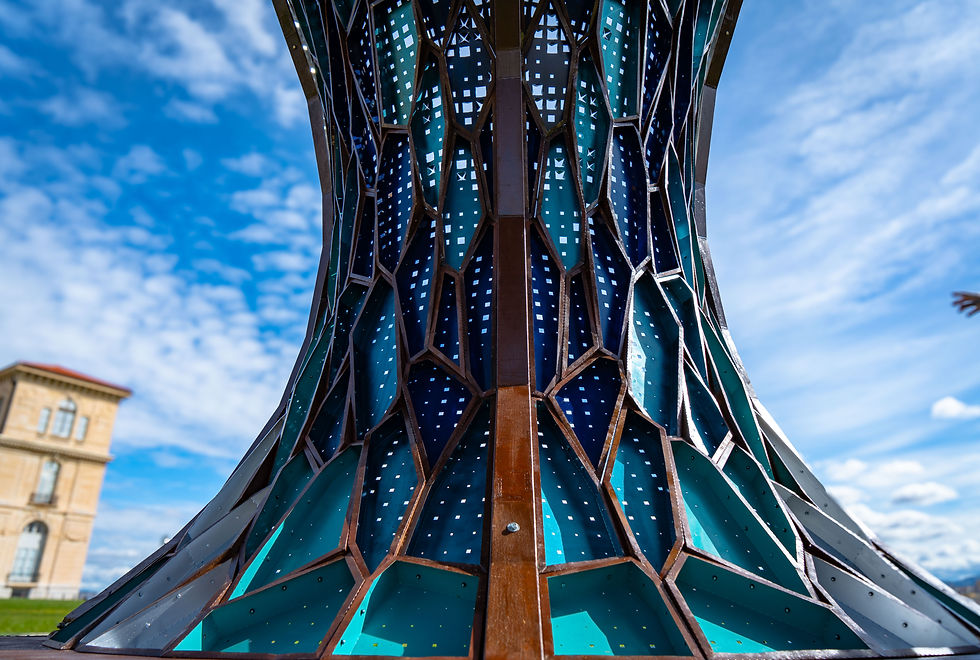
One does not so much arrive at Mar Nostro as enter into it. There is no singular façade to face, nor definitive threshold to cross. The structure opens outward in several directions at once, where orientation becomes less an act of seeing than of sensing. Only once inside, beneath the shifting light, surrounded by folded panels of metal that catch and release the air through their sharp intervals, does the space begin to make itself known.
486 panels, each hand-folded, assembled on site through entirely old-school means that belong to another rhythm of making: the patient labour of hands, the passing of hours, the quiet accumulation of know-how (savoir-faire). Yet each of those panels first existed in the immaculate abstraction of parametric design and fabricated with millimeter precision using advanced digital processes. The contrast between these two methods is deliberate. The exactness of the design and the humanity of its making belong to the same gesture; a choice made out of respect for the sensitivity and the particularity of this heritage site, where no machine could substitute for the careful presence of people at work.
And the work itself aimed, almost instinctively, to gather people around it. Mar Nostro was built as a participatory chantier alongside the Cascadeurs and Cascadeuses of the Cité des Arts de la Rue, piece by piece, hand by hand. People came together around the metal and stayed there through the long hours of cutting, folding, lifting and fitting, through a collective process in which making and meaning were inseparable, where the act of construction was itself a form of encounter. By the end, the installation carried more than metal and geometry. It carried the mark of the people who stood inside it together and built it slowly under the open sky of Marseille.


On the name
The title does not announce itself innocently. Mar Nostro lingers at the edge of a familiar phrase, from another register, from another century, that now returns carrying with it the faint pressure of a memory and to displace that old connotation. Mar Nostro, the title of this artwork, echoes Mare Nostrum, that old imperial formula by which Rome claimed the Mediterranean as “our sea”, and enclosed it within the grammar of possession, turning it into a territory, an interior lake of empire. That assertion of ownership is turned here into a question.
Who, in fact, is this “we”, today? Who shares this sea, and who has been left outside its horizon? Who bears its cost?
The name also carries another resonance. It refers to the Lingua Franca, that hybrid, improvised tongue of Mediterranean ports, where Italian, Arabic, Spanish, French, and many other idioms met and blended without hierarchy or purity. A language not anchored in a single nation or origin, but formed in passage, in encounters, in necessity; spoken by sailors and merchants, by travelers and exiles, by those who had no shared home except the precariousness of the movement itself. A language that belonged to everyone, and held the difference together without resolving it. Mar Nostro is spoken in that spirit.


The structure
From a distance, it might read as a hull, a ruin, a shelter, or a sea shell. Up close, the eye is drawn into its geometry, the precise logic of each fold, the way panels catch and redirect light. Its openings frame the city beyond: glimpses of Marseille held briefly between the metal surfaces, as if the installation and the urban landscape were in quiet dialogue. The structure does not enclose so much as gather.
Step beneath it and the light becomes entirely alive. A moving constellation, shifting hour by hour, with the position of the body, with the angle of the sun. It recalls the distant stars that once guided those crossing open water; travelers, navigators,, sailors and exiles, those who travelled without a map, reading the night sky, as it was the only language vast enough to guide them .
No singular axis around which the structure organizes itself. There is no north or south here. No center, nor periphery. No main façade, nor imposed direction. Three passages open outward, not toward fixed continents, but toward the flows between them. Africa, Asia, Europe: not as separate blocks, but as a presence long entangled through the Mediterranean; through commerce, migration, memory, conflict and desire. In Mar Nostro there is no hierarchy between them, it simply allows their proximity to be felt again, as living realities that have always breathed together, across and through this sea.


The sea itself
The Mediterranean, beside which the structure stands, is not only a geography traced upon maps. It is a human material, shaped over centuries by displacement, exchange, conflict, and the slow accumulation of stories told and retold. It is layered with the weight of innumerable lives; voices spoken across harbours, departures undertaken without certainty, arrivals marked by hope, fear and exhaustion. So too the installation that shifts and transforms with every person who moves through it , as the Mediterranean itself has always been shaped and transformed by the countless movements of people across its history.
For centuries, empires attempted to claim this sea within the language of ownership. They drew borders on its shores, imposed names, declared possession. Yet the Mediterranean has always exceeded those claims. It has nurtured the encounters between civilizations, languages, and cultures that went on to build cities along its coasts and develop societies on its shores. It has fed commerce and carried conquest. And it is also marked by exile; by the thousands of women, men, and children who have lost their lives upon it, simply in search of a better future.
This is why the Mediterranean ultimately refuses every claim made upon it. It belongs above all to the peoples who cross it, inhabit it, and keep it alive.
Marseille is a living proof of this. Built across generations who came from every shore and beyond, carrying languages, music, cultures, recipes, memories, griefs and hopes, all of which entered slowly into the life of the city until they became inseparable from it. Marseille still carries today this history of movement and mixing. It embodies this conversation, not through isolation, but through the continuous encounter, memory and transformation.